Development Of A Comprehensive Technological Solution For A Comfortable And Green Classroom At A School
1. INTRODUCTION
1.1 Background
Schools play a crucial role in the holistic development of students, and creating a comfortable learning environment is essential for their academic progress. Temperature control in classrooms is one of the key factors that contribute to student comfort and performance. This innovation presents the development of a comprehensive technological solution aimed at ensuring a comfortable temperature range (22-24 degrees Celsius) in classrooms, while simultaneously incorporating green and sustainable practices.
1.2 Problem Statement
Traditional classrooms often struggle to maintain a consistent and comfortable temperature range, leading to discomfort, distractions, and decreased productivity among students. Additionally, the dependence on non-renewable energy sources for temperature control adds to environmental concerns and operational costs. Therefore, there is a need for an innovative and sustainable solution that addresses both temperature control and environmental sustainability in classrooms.
1.3 Objective of the Project
This project aims to present a comprehensive technological solution that combines temperature control and green practices for comfortable and
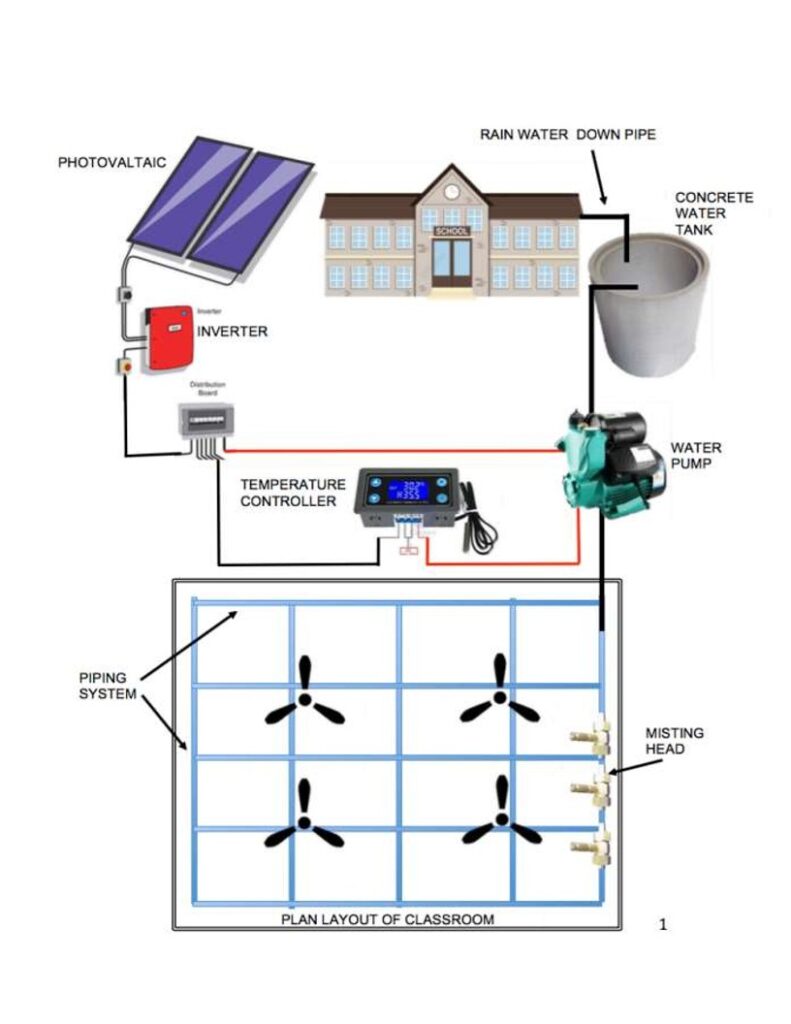
sustainable classrooms. The solution incorporates a temperature sensor, rainwater collection system, a pump powered by solar energy, and a unique misting mechanism. Emphasis is placed on highlighting that the system utilizes free and green energy from a solar power system.
2. METHODOLOGY
2.1 Project and Development Process
The project and development process involved the selection of appropriate components and technologies. The solution was then developed and
integrated into a classroom setting.
2.2 Selection of Components and Technologies
The selection of components was based on their compatibility with the desired temperature control range and their ability to operate using green energy sources. The temperature sensor ensured accurate monitoring and control of the classroom’s temperature. The rainwater collection system facilitated water conservation, while the solar-powered pump allowed for the utilization of renewable energy. Finally, the unique misting mechanism ensured efficient cooling while minimizing water consumption.
2.3 Testing and Integration
The developed solution was rigorously tested to assess its performance in real-world conditions. Data on temperature control, water consumption, and energy consumption were collected and analyzed. The components were integrated to form a cohesive system, ensuring seamless operation and effective temperature control.
3. TECHNOLOGICAL SOLUTION
3.1 Temperature Sensor
The core element of this innovation is the temperature control system that utilizes advanced temperature sensors. These sensors constantly monitor the classroom temperature and send real-time data to a central control unit. When the temperature exceeds 24 degrees Celsius, the control unit triggers the pump system to initiate the cooling process. It is strategically placed to accurately measure the temperature and transmit the data to the control system.
3.2 Rainwater Collection System
To promote sustainability, a rainwater collection system is implemented to collect and store rainwater for various uses within the classroom. Rainwater is collected from rooftops, gutter systems, and rain downpipes installed across the school buildings. The collected rainwater is channeled through a specially designed culvert stone-covered tank, ensuring an ample supply of water for the misting process.
3.3 Solar-Powered Pump
To reduce dependency on conventional electricity sources, the pump system is powered by solar energy. Photovoltaic panels installed on the roof of the classroom building harness solar energy and convert it into electricity. This renewable energy source ensures the sustainability and cost-effectiveness of the operation, minimizing the carbon footprint associated with traditional cooling systems. In summary can conclude that a solar-powered pump is integrated into the system to circulate water from the rainwater collection system. By harnessing solar energy, the pump minimizes energy consumption while effectively distributing water to the misting mechanism
3.4 Unique Misting Mechanism
When the pump system is activated by the control unit, a fine mist of precooled rainwater is emitted into the classroom through a specialized misting head. By releasing a controlled mist, the system ensures that the surrounding surfaces remain dry while effectively lowering the overall temperature. This misting technique prevents water damage to classroom materials and ensures a comfortable learning environment for students and teachers alike. Overall can be summarized that the misting mechanism utilizes the collected rainwater to create a fine mist that helps regulate the temperature within the classroom. The misting system is designed to ensure even distribution throughout the space, providing optimal cooling while minimizing water usage.
4. SYSTEM IMPLEMENTATION
4.1 System Design and Configuration
The solution is designed to accommodate the specific requirements of a classroom setting, considering factors such as size, insulation, and ventilation. The system is configured to maintain the desired temperature range while utilizing the available solar energy efficiently.
4.2 Component Installation
The installation process involves the careful placement of the temperature sensor, rainwater collection system, solar-powered pump, and misting mechanism.
4.3 Integration of Components
Once the individual components were installed, they were integrated to form a cohesive system. Integration involved connecting the temperature sensor to the control system and linking the rainwater collection system to the solarpowered pump and misting mechanism. Thorough testing was conducted to ensure seamless communication and operational efficiency between all components.
5. BENEFITS OF THE SYSTEM
5.1 Comfortable Temperature Range
The implemented technological solution enables classrooms to maintain a comfortable temperature range (22-24 degrees Celsius) throughout the day. This provides an optimal learning environment for students, fostering concentration, engagement, and academic performance.
5.2 Energy Efficiency
By utilizing solar energy and incorporating components with low energy consumption, the system significantly reduces reliance on non-renewable energy sources, leading to decreased energy costs and a smaller carbon footprint.
5.3 Environmental Sustainability
The inclusion of a rainwater collection system and the efficient use of water through the misting mechanism promote environmental sustainability. The system minimizes water waste and ensures efficient use of available resources.
6. RESULTS AND FINDINGS
6.1 Data Analysis of Temperature Control
Data collected during testing demonstrated the system’s ability to maintain the desired temperature range consistently. The temperature sensor accurately detected variations and facilitated real-time adjustments for optimal temperature control.
6.2 Water Consumption Analysis
Analyzing water consumption revealed that the rainwater collection system effectively provided a sustainable water source for the misting mechanism. Water consumption was kept to a minimum while still achieving efficient cooling.
6.3 Energy Consumption Analysis
The integration of the solar-powered pump significantly reduced energy consumption compared to traditional pumping systems. This analysis
highlighted the system’s commitment to utilizing green energy and reducing operational costs.